SEISMIC VULNERABILITY OF EDUCATIONAL BUILDINGS PRE- AND POST-NEC IN CUENCA, ECUADOR
DOI:
https://doi.org/10.18867/ris.114.699Keywords:
non-linear analysis, seismic vulnerability, Seismic riskAbstract
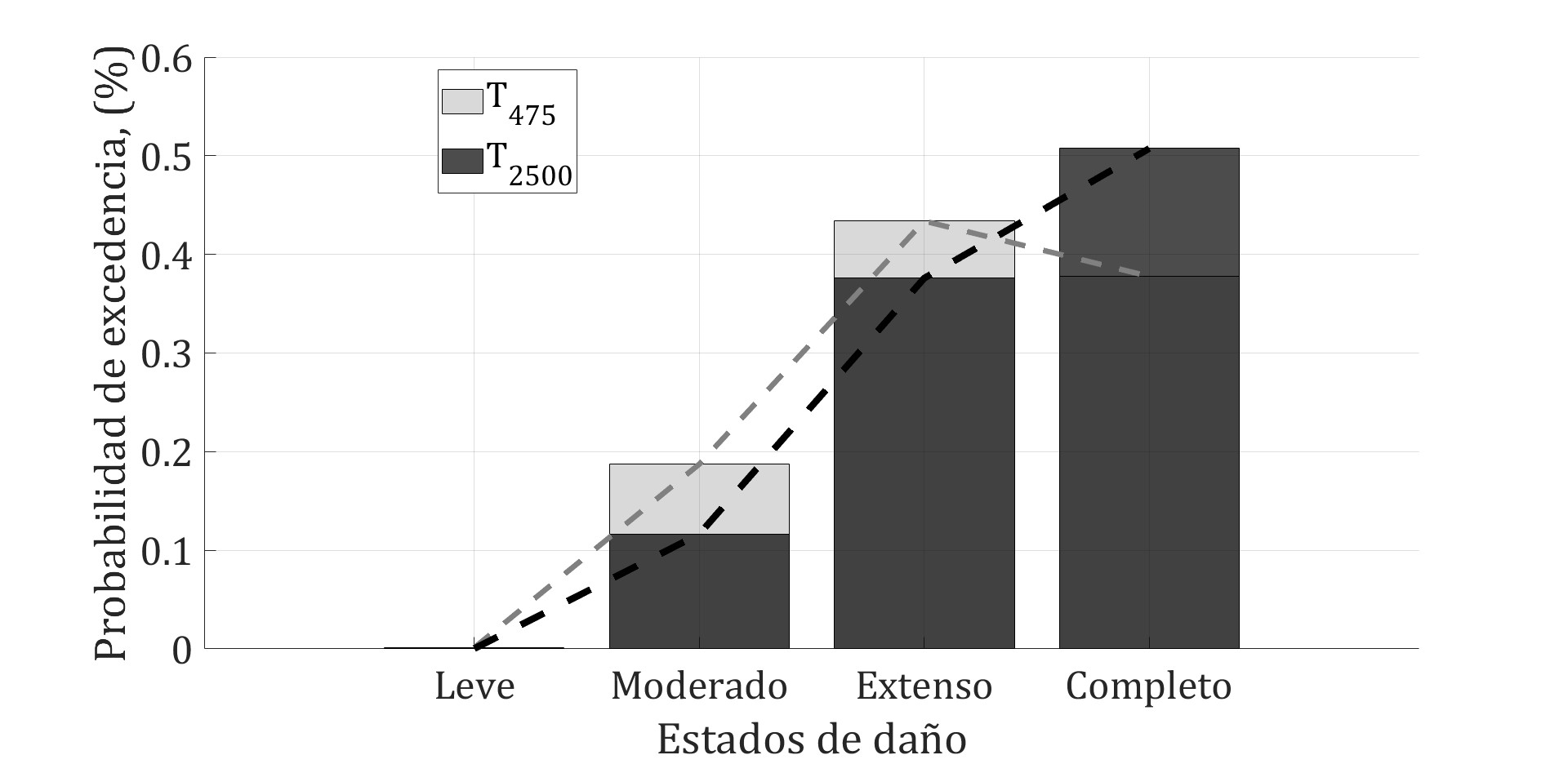
Ecuador is located in the Pacific Ring of Fire, the principal source of most of the world's strongest earthquakes and, in particular, of some of the most destructive seismic events recorded in Ecuadorian territory. This study examines the performance and seismic vulnerability of two educational buildings designed before the publication of the Ecuadorian Construction Code (NEC) and one constructed afterwards, to determine whether structures conceived prior to this regulation are more vulnerable than those designed later. The ETABS software was used for structural modelling and obtaining the capacity curve, and a performance analysis was conducted using the equivalent linearization method described in the FEMA 440 document. Subsequently, fragility was assessed based on the HAZUS criterion. The results indicate that structures built prior to the NEC must be evaluated and retrofitted to ensure proper performance and the safety of their occupants. Therefore, pre-NEC buildings should be studied on a larger scale to enhance seismic risk management.
Downloads
References
Applied Technology Council. (1996). ATC-40, Seismic Evaluation and Retrofit of Concrete Buildings. Technical report, Seismic Safety Commission, Redwood City, California.
Avila Guamán, L. O., Bueno Pulla, D. N., & Ávila Guamán, J. A. (septiembre-octubre de 2024). Evaluation of the seismic vulnerability of typical buildings in the urban area of Cuenca by means of simulation and multivariate techniques. Ciencia Latina, 8(5), 10538-10551. doi:https://doi.org/10.37811/cl_rcm.v8i5.14427
Cabrera, E. (2023). Metodología para estimación del daño sísmico en edificios en base a modelos numéricos avanzados y monitorizaciones RAR. Tesis doctoral, Universidad Politécnica de Cataluña, UPC - Barcelonatech, Barcelona. Recuperado el 27 de Febrero de 2025, de https://upcommons.upc.edu/handle/2117/396558
Cabrera, E., González-Drigo, R., Luzi, G., Vargas-Alzate, Y., Pujades, L., Alva, R., & Avila-Haro, J. (2022). Simulation and analysis of damage progression in a mid-rise RC building during an earthquake. Proceedings of the 3rd European Conference on Earthquake Engineering & Seismology, (págs. 1128-1137). Bucharest.
Cabrera, E.; González-Drigo, R.; Luzi, G.; Vargas-Alzate, Y.; Pujades, L. (2018). Real Aperture Radar an Interferometric Technique to Assess Earthquake Damaged Structures. 16TH European Conference on Earthquake Engineering (16ECEE), (pág. 12). Thessaloniki.
Computers & Structures, Inc. (CSI). (2024). ETABS: Building analysis and design V 22.3.0. Obtenido de https://www.csiamerica.com/
Crisafulli, F. J. (2018). Diseño sismoresistente de construcciones de acero. Mendoza, Argentina.
Egred, J. (2000). El Terremoto de Riobamba. Recuperado el 17 de Febrero de 2025, de Instituto Geofísico de la Escuela Politécnica Nacional: https://www.igepn.edu.ec/publicaciones-para-la-comunidad/23-el-terremoto-de-riobamba-de-1797/file
FEMA. (2000). FEMA 356, Pre-Standard and Commentary for the Seismic Rehabilitation of Building. Washington, DC.
FEMA/NIBS. (2020). Hazus earthquake model. Technical manual. Hazus 4.2 SP3. Recuperado el 27 de Febrero de 2025, de https://www.fema.gov/sites/default/files/2020-10/fema_hazus_earthquake_technical_manual_4-2.pdf
FEMA-440/ATC55. (2005). FEMA-440/ATC-55. Improvement of Nonlinear Static Seismic Analysis Procedures. Federal Emergency Management Agency/Applied Technical Council, California, U.S.A.
Gonzalez-Drigo, R., Cabrera, E., Luzi, G., Pujades, L. G., Vargas-Alzate, Y. F., & Avila-Haro, J. (2019). Assessment of post-earthquake damaged building with interferometric real aperture radar. Remote Sensing, 11(3), 2830. doi:10.3390/rs11232830
Grünthal, G. (1998). European Macroseismic Scale 1998 (EMS-98) European Seismological Commission, sub commission on Engineering Seismology, Working Group Macroseismic Scales. Conseil de l’Europe, Cahiers du Centre Européen de Géodynamique et de Séismologie (Vol. 15). Luxenbourg. Obtenido de https://www.franceseisme.fr/EMS98_Original_english.pdf
Gutemberg, B., & Richter, C. (1956). Earthquake Magnitude, Intensity, Energy and Acceleration. Bulletin of the Seismological Society of America, 46(2), 105-145. doi:10.1785/BSSA0460020105
Hernández, C., & Santacruz, F. (2024). Análisis de vulnerabilidad sísmica de un edificio de estructura metálica para uso especial. Trabajo de titulación de Ingeniero Civil, Universidad del Azuay, Cuenca. Obtenido de https://dspace.uazuay.edu.ec/handle/datos/14583
Hernández, S., Ortiz, M., Barros, J., Segovia, M., Vaca, S., & Viracucha, E. (18 de Marzo de 2023). Informe sísmico especial No. 2023-003. Recuperado el 17 de Febrero de 2025, de Instituto Geofísico de la Escuela Politécnica Nacional: https://www.igepn.edu.ec/servicios/noticias/2024-informe-sismico-especial-no-2023-003
Instituto Geofísico. (7 de Febrero de 2012). El Terremoto de Riobamba del 4 de Febrero de 1797. Recuperado el 17 de Febrero de 2025, de Instituto Geofísico de la Escuela Politécnica Nacional: https://www.igepn.edu.ec/servicios/noticias/582-el-terremoto-de-riobamba-del-4-de-febrero-de-1797
Instituto Geofísico. (30 de Enero de 2012). Terremoto de Esmeraldas de 1906 - Uno de los sismos más grandes de la historia reciente. Recuperado el 17 de Febrero de 2025, de Instituto Geofísico de la Escuela Politécnica Nacional: https://www.igepn.edu.ec/servicios/noticias/575-terremoto-de-esmeraldas-de-1906-uno-de-los-sismos-m%C3%A1s-grandes-la-historia
JCS, AL, CV, & MR. (4 de Mayo de 2016). Informe sísmico especial N. 18 - 2016. Recuperado el 17 de Febrero de 2025, de Instituto Geofísico de la Escuela Politécnica Nacional: https://www.igepn.edu.ec/servicios/noticias/1324-informe-sismico-especial-n-18-2016
Jiménez Pacheco, J., Cabrera Cajamarca, J., Sánchez Beltrán, J., & Avilés Tenorio, F. (2018). Vulnerabilidad sísmica del patrimonio edificado del centro histórico de la cuidad de Cuenca: Lineamientos generales y avances del proyecto. MASKANA, 9(1), 59-78. doi:10.18537/mskn.09.01.07
Kappos, A. J. (1997). Seismic damage indices for RC buildings: evaluation of concepts and procedures. Progress in Structural Engineering and materials, 1(1), 78-87. doi:10.1002/pse.2260010113
Luzi, G., Monserrat, O., & Crosetto, M. (2012). The Potential of Coherent Radar to Support the Monitoring of the Health State of Buildings. Research in Nondestructive Evaluation, 23(3), 125-145. doi:10.1080/09349847.2012.660241
Milutinovic, Z. V., & Trendafiloski, G. (2003). Risk-UE An advanced approach to earthquake risk. WP4: Vulnerability of current buildings. Risk-UE project Handbook.
Ministerio de Desarrollo Urbano y Vivienda. (2014). Peligro Sísmico: Diseño Sismo Resistente. Norma Ecuatoriana de la Construcción (NEC), Quito. Recuperado el 2023, de https://www.habitatyvivienda.gob.ec/documentos-normativos-nec-norma-ecuatoriana-de-la-construccion/
Molina Cabrera, M., & Rubio Vintimilla, N. (2023). Influencia del tipo del suelo en la determinación del punto de desempeño en una estructura. Trabajo de titulación, Universidad del Azuay, Cuenca. Obtenido de https://dspace.uazuay.edu.ec/handle/datos/13390
Quinde Martínez, P., & Reinoso Angulo, E. (2016). Estudio de peligro sísmico de Ecuador y propuesta de espectros de diseño para la ciudad de Cuenca. Revista de Ingeniería Sísmica(94), 1-26. Recuperado el 18 de Febrero de 2025, de https://www.scielo.org.mx/scielo.php?script=sci_arttext&pid=S0185-092X2016000100001
Redacción Elcomercio.com. (18 de Marzo de Marzo de 2023). 14 fallecidos y 381 heridos por fuerte terremoto en Ecuador. El Comercio. Obtenido de https://www.elcomercio.com/actualidad/ecuador/fallecido-fuerte-sismo-ecuador.html
Riquetti, J. (2014). Estudio geotécnico de la Universidad del Azuay. Geotécnico, Cuenca.
Ruiz, M. (31 de Enero de 2024). El gran terremoto del 31 de enero de 1906. Recuperado el 17 de Febrero de 2025, de Instituto Geofísico de la Escuela Politécnica Nacional: https://www.igepn.edu.ec/interactuamos-con-usted/2101-el-gran-terremoto-del-31-de-enero-de-1906
SEAOC. (1995). Vision2000: performance based seismic engineering of buildings. Sacramento: Structural Engnieers Association of California.
Secretaría Nacional de Gestión de Riesgos. (18 de Julio de 2016). El terremoto de 1797 ha sido el más devastador de Ecuador. Recuperado el 17 de Enero de 2025, de Secretaría Nacional de Gestión de Riesgos: https://www.gestionderiesgos.gob.ec/el-terremoto-de-1797-ha-sido-el-mas-devastador-de-ecuador/
The Mathworks Inc. (2022). Matlab the Language of Scientific Computing. r2022b. Recuperado el 24 de Agosto de 2022, de https://www.mathworks.com/
Vidal, F., Navarro, M., Aranda, C., & Enomoto, T. (2014). Changes in dynamic characteristics of Lorca RC buildings from pre- and post- earthquake ambient vibration data. Bulletin of Earthquake Engineering, 12(5), 2095-2110. doi:10.1007/s10518-013-9489-5


Published
Versions
- 2025-12-10 (2)
- 2025-12-10 (1)
How to Cite
Issue
Section
License
Copyright (c) 2025 Journal Earthquake Engineering

This work is licensed under a Creative Commons Attribution-NonCommercial 4.0 International License.