
Dr. RESILIENCIA FINANCIERA Y MEDIDAS DE MITIGACIÓN A PARTIR DE RESULTADOS DE PÉRDIDAS ESTIMADAS PARA LA CIUDAD DE MÉXICO
DOI:
https://doi.org/10.18867/ris.115.708Palabras clave:
resiliencia financiera, pérdidas económicas, mitigación, Ciudad de MéxicoResumen
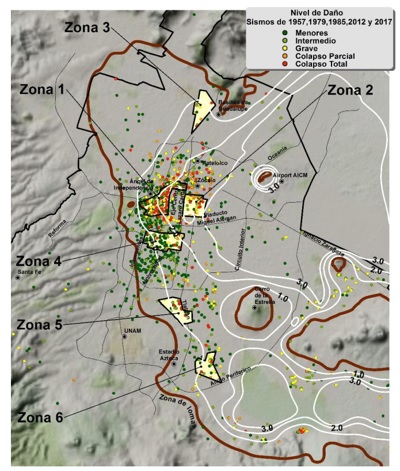
En este artículo se estiman los niveles de pérdidas económicas en edificios de la Ciudad de México para sismos importantes. Mediante la elaboración de una base de datos de edificios de la ciudad que contiene características geométricas, dinámicas, etc. y un sistema de cálculo de pérdidas se simularon los escenarios de los sismos del 19 de septiembre de 1985 y 2017. Se realizó una revisión de las zonas con mayores pérdidas durante los sismos antes mencionados, obteniendo resultados congruentes a los observados. Los resultados indican que la base de datos tiene un buen nivel de calibración para realizar futuros análisis. Finalmente se analizan las características más recurrentes en edificios con pérdidas altas y se ofrecen medidas de mitigación del riesgo tomando en cuenta las características más recurrentes de los edificios con pérdidas altas.
Descargas
Citas
McGuire, R. K (1995), “Probabilistic Seismic Hazard Analysis and Design Earthquakes: Closing the Loop”, Bulletin of the Seismological Society of America, 85(5), 1275–1284. DOI: 10.1016/0148-5-279062(96)83355-9
Ordaz, M., Miranda, E., Reinoso E y Pérez-Rocha, LE, (2000), “Seismic loss estimation for Mexico City”, XII Congreso mundial de Ingeniería Sísmica, CD.
García, A y Suárez, R (1996), ”Los sismos en la historia de México”, Fondo de Cultura Económica.
Cruz, V (2016), “Long duration of ground motion in the paradigmatic valley of Mexico”, Nature-Scientific Reports, 6.
Jaimes, M., Reinoso, E. y Ordaz, M (2006), “Comparison of methods to predict response spectra at instrumented sites given the magnitude and distance of an earthquake”, Journal of Earthquake Engineering, 10(6), pp. 887–902
Jaimes, M., Reinoso, E. y Ordaz, M (2008), “Empirical Green’s functions modified by attenuation for sources located at intermediate and far distances from the original source”, Journal of Earthquake Engineering, 12, pp. 584–595
Okada, S y Takai, N (1999), “Classifications of structural types and damage patterns of buildings for earthquake field investigation”, en Memorias del XII Congreso Mundial de Ingeniería Sísmica. Ackland, Nueva Zelanda
Reinoso, E. y Ordaz, M (1999), “Spectral ratio for Mexico City from free-field recordings”, Earthquake Spectra, 23, pp. 273–295
Reinoso, E. y Ordaz, M (1999), “Spectral ratios for Mexico City from free-field recordings”, Earthquake Spectra. DOI: 10.1193/1.1586041
Gómez, D., Torres, M. A., Reinoso, E, (2015), “Realce geométrico de imágenes de muy alta resolución y extracción de catastro a través de GEOBIA en áreas con alta densidad urbana”, SELPER-XXI-México-UACJ- 2015. Memorias en extenso
Kang, J., Körner, M., Wang, Y., Taubenböck, H., Xiang Zhu, X (2018), “Building instance classification using street view images”, ISPRS Journal of Photogrammetry and Remote Sensing 145, 44-59
Singh, S. K., Reinoso, E., Arroyo, D., Ordaz, M., Cruz-Atienza, V., Pérez-Campos, X., Iglesias, A., et al., 2018. Deadly Intraslab Mexico Earthquake of 19 September 2017 (Mw 7.1): Ground Motion and Damage Pattern in Mexico City. Seismological Research Letters, 89(6), 2193–2203. DOI: 10.1785/0220180159
FEMA (2015), “Rapid visual screening of buildings for potential seismic hazards: a handbook”, FEMA P-154, Tercera edición
Galvis, F., Miranda, E., Heresi, P., Dávalos, H., y Silos, J. R (2017), “Preliminary Statistics of Collapsed Buildings in Mexico City in Puebla-Morelos Earthquake”, Technical Report, October, 17. https://www.researchgate.net/publication/320297374
Abrahamson, N., Gregor, N., and Addo, K (2016), “BC hydro ground motion prediction equations for subduction earthquakes”, Earthquake Spectra, 32(1), 23–44. DOI: 10.1193/051712EQS188MR
Cruz-Atienza, V. M., Ito, Y., Kostoglodov, V., Hjörleifsdóttir, V., Iglesias, A., Tago, J., Calò, M (2018),
“A seismogeodetic amphibious network in the Guerrero Seismic Gap, Mexico”, Seismological Research Letters, 89(4), 1435–1449. DOI: 10.1785/0220170173
Cruz-Atienza, V. M., Tago, J., Sanabria-Gómez, J. D., Chaljub, E., Etienne, V., Virieux, J., y Quintanar, L (2016), “Long Duration of Ground Motion in the Paradigmatic Valley of Mexico”, Scientific Reports, 6(June), 1–9. Nature Publishing Group. DOI: 10.1038/srep38807
Domínguez, J., Suárez, G., Comte, D., y Quintanar, L (2006), “ Seismic velocity structure of the Guerrero gap, Mexico”, Geofisica Internacional, 45(2), 129–139. DOI: 10.22201/igeof.00167169p.2006.45.2.187
Ordaz, M., Singh, S. K., Lermo, J., Espinosa-Johnson, M., and Dominguez, T (1988), “The Mexico Eartjquake of September 19, 1985: Estimation of REsponse Spectra in the Lake Bed Zone of the VAlley of Mexico”, Earthquake Spectra, 4(4)
Ordaz, M., Singh, S. K., Reinoso, E., Lermo, J., Espinosa-Johnson, M., y Dominguez, T (1988), “The Mexico Earthquake of September 19, 1985 - Estimation of Response Spectra in the Lake Bed Zone of the Valley of Mexico”, Earthquake Spectra, 4(4), 815–834
Singh, S. K., Astiz, L., and Havskov, J (1981), “Seismic gaps and recurrence periods of large earthquakes along the Mexican subduction zone: A reexamination”, Bulletin of the Seismological Society of America, 71(3), 827–843. DOI: 10.1785/bssa0710030827
Descargas

Publicado
Cómo citar
Número
Sección
Licencia
Derechos de autor 2026 Revista Ingeniería Sísmica

Esta obra está bajo una licencia internacional Creative Commons Atribución-NoComercial 4.0.


